ReticleBench may earn an affiliate commission when you purchase through links on this page, at no additional cost to you. Learn how ReticleBench is reader-supported
When you need to inspect an unseated SMD component, verify a cracked trace on an assembled chassis, or check tool wear away from your workbench, dragging an assembly over to a dedicated inspection station is often impossible. Handheld digital microscopes solve that problem by combining an image sensor, front-facing illumination, and an integrated display into a battery-operated wand or pocket gauge.
However, navigating the handheld category requires cutting through marketing hyperbole. Budget listings routinely boast "1000X magnification" or "4K resolution" on devices driven by modest 2.0-megapixel sensors. To make an informed choice, you must weigh optical working distance, screen ergonomics, and handheld stability against your actual inspection workflow.
Understanding Handheld Inspection: The Real Constraints
Before evaluating specific listings, consider the fundamental physics that govern handheld digital inspection:
- Digital Enlargement vs. True Optical Magnification: In digital microscopes, total magnification is calculated by comparing the image size on the built-in display or monitor to the target's physical size. As detailed in technical analyses of digital magnification by Microscopy-UK, most compact digital scopes operate with modest primary optical magnification; higher claimed zoom figures (such as 500X or 1000X) are largely digital crops that magnify existing sensor pixels rather than resolving finer optical details.
- Working Distance and Hand Tremor: Optical physics dictates that as magnification increases, depth of field and working distance shrink rapidly, while the field of view contracts. When holding a scope against an object without a mechanical rig, micro-tremors in your hands introduce significant motion blur at high zoom ratios. Most handheld wands achieve their sharpest images when rested directly against the surface or stabilized against a flat edge.
- Working Clearance for Tools: Handheld wands with shroud-style hoods sit within millimeters of the target. They are designed for spot inspection—checking solder joints, coin surfaces, or plant leaves—not for active rework. If you need room to maneuver a soldering iron or tweezers under the lens, explore our guide to benchtop digital microscopes, which prioritize vertical clearance and rigid pillar stands.
Screen-Integrated Wands for Rapid Spot-Checking
The most common portable form factor resembles an oversized loupe or inspection wand. An integrated IPS screen sits directly above or beside the grip, letting you view real-time video without tethering the unit to an external monitor or laptop.

Advertised high zoom often limits working distance under the lens. Verify soldering iron clearance before mounting.
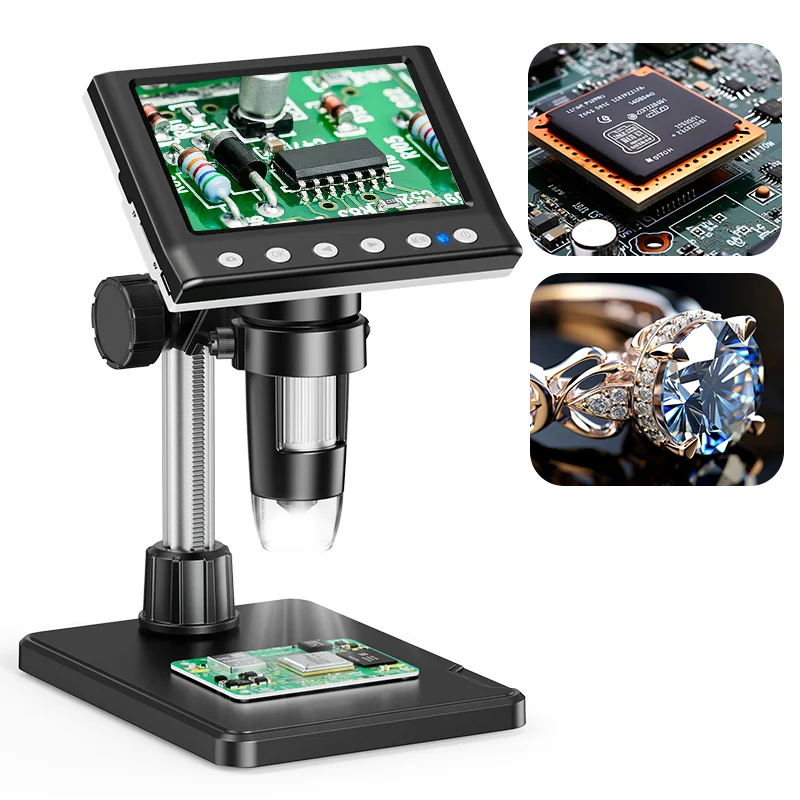
Listing #1 (offered by Stone's Store at a reference price of $24.89 captured in October 2026) exemplifies the vertical wand design. It pairs a 2.8-inch IPS screen with advertised 1080P output and claims a conservative 100X zoom ratio alongside a 2.0-megapixel sensor. The seller's product graphics indicate multi-mode lighting—advertised as 3-in-1 illumination (white, warm, and ultraviolet wavelengths)—which can be helpful when examining conformal coatings or forensic surfaces that fluoresce under UV light.
When a handheld scope advertises multi-spectral or UV illumination, check whether the lighting modes can be toggled independently via hardware buttons or if they cycle automatically through firmware menus during live inspection.
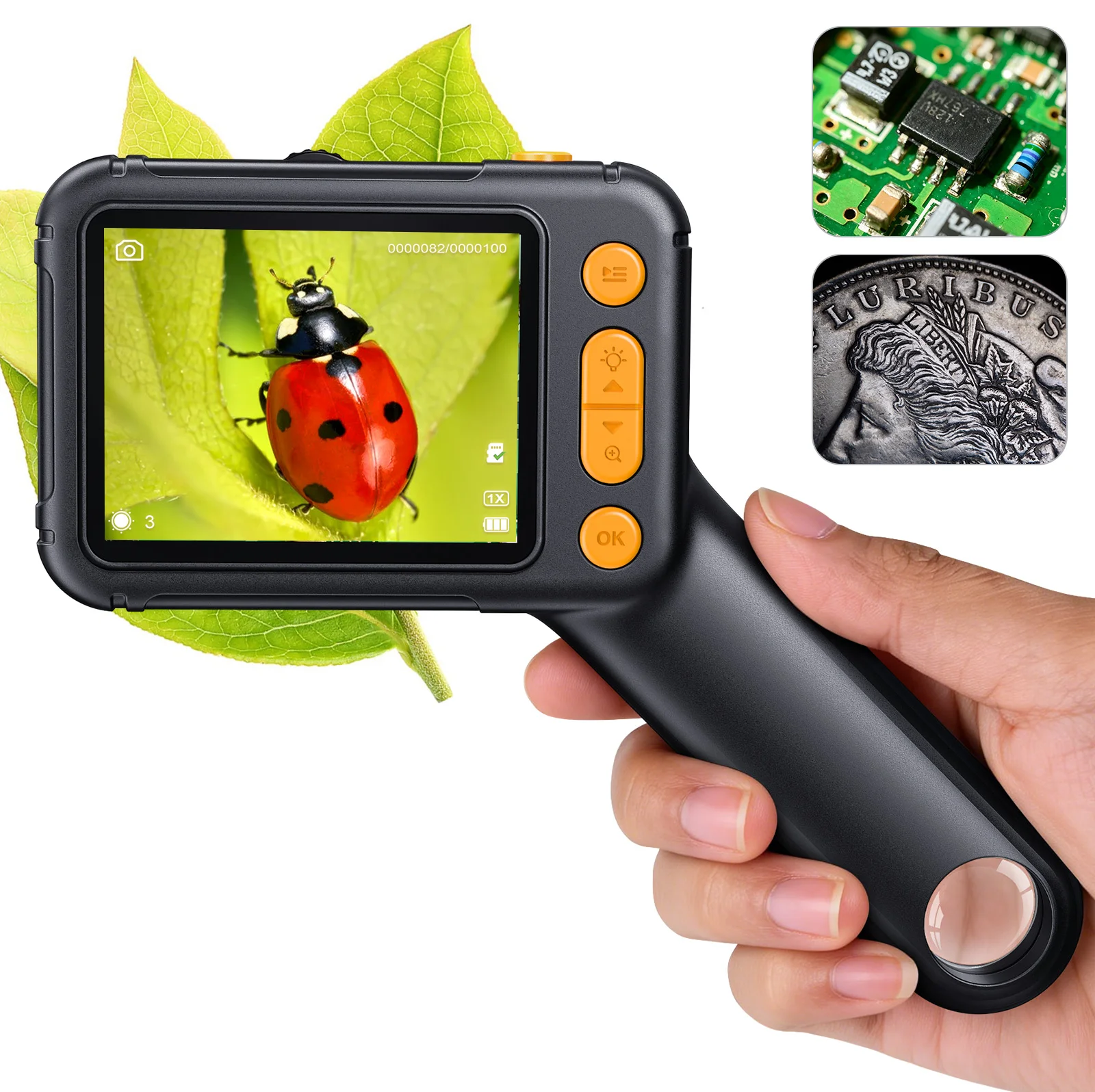
For users who prefer a horizontal layout, listing #4 (offered by Gevnnik Tool Store at a reference price of $27.69) positions a 2.8-inch IPS panel in a lateral handle configuration. The seller advertises a 2MP camera module and claims 500X magnification.
Advertised high zoom often limits working distance under the lens. Verify soldering iron clearance before mounting.
The horizontal orientation can make resting the instrument on a flat circuit board easier during passive inspection, reducing wrist fatigue compared to holding a vertical wand upright over long viewing periods.
Pocket Gauges and Hybrid Stand Units
If pocketability is your main concern, smaller form factors trim display real estate to slip inside an everyday carry pouch or mobile field kit.
Advertised high zoom often limits working distance under the lens. Verify soldering iron clearance before mounting.
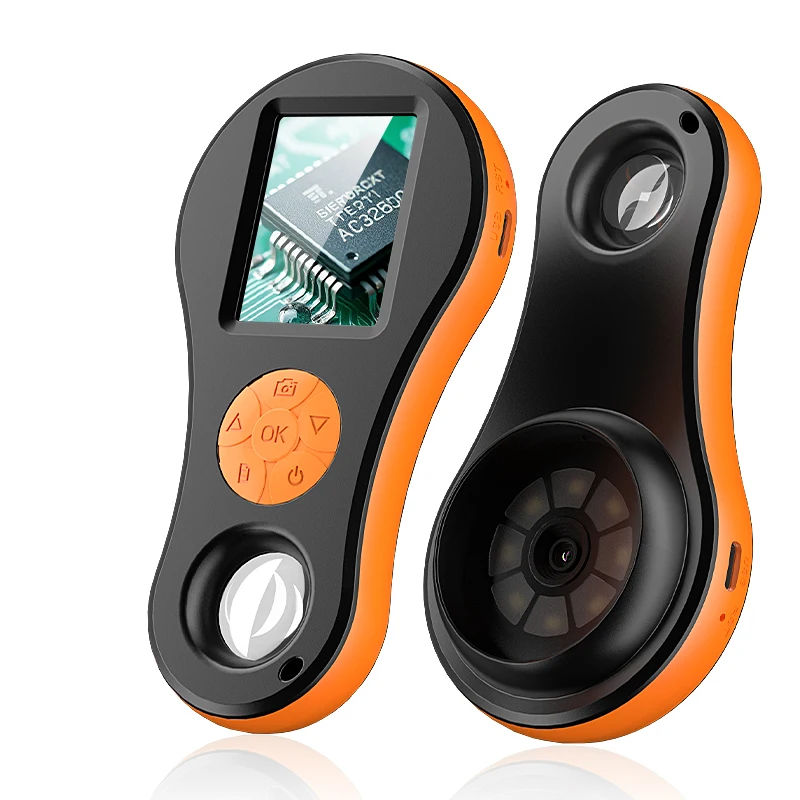
Listing #2 (from Shop1105185178 Store at $17.89) downsizes the panel to a 2.0-inch IPS screen. Its compact chassis incorporates a directional button cluster and a recessed front objective. While a smaller screen requires you to look closer to spot trace cracks, the reduced footprint makes it well-suited for tight service bays or industrial field runs where bulkier tools are cumbersome.
At the opposite end of the portable spectrum are hybrid units that combine a detachable head with a tabletop mechanism.
Advertised high zoom often limits working distance under the lens. Verify soldering iron clearance before mounting.
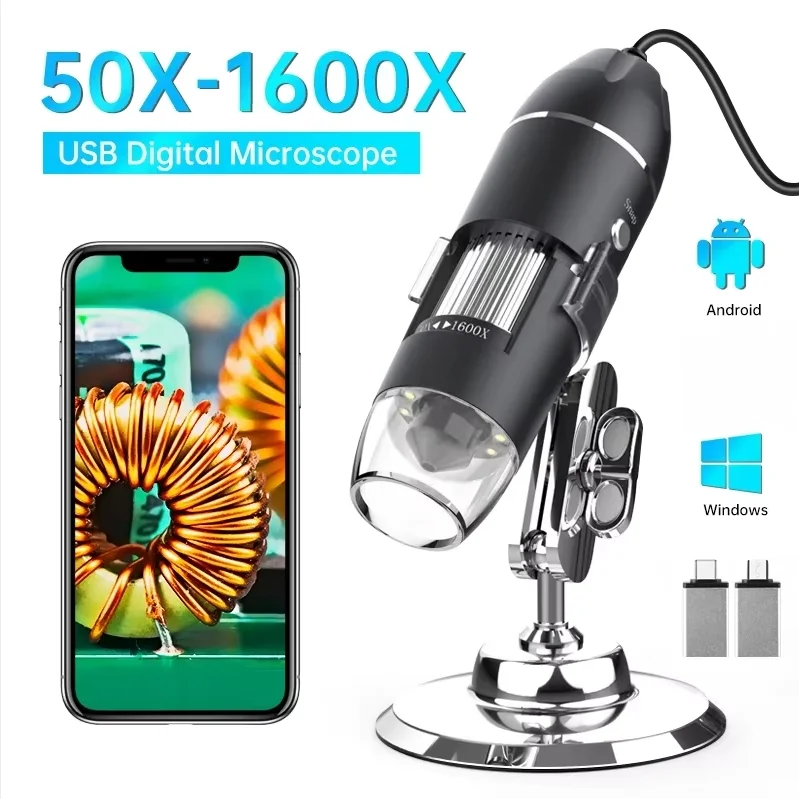
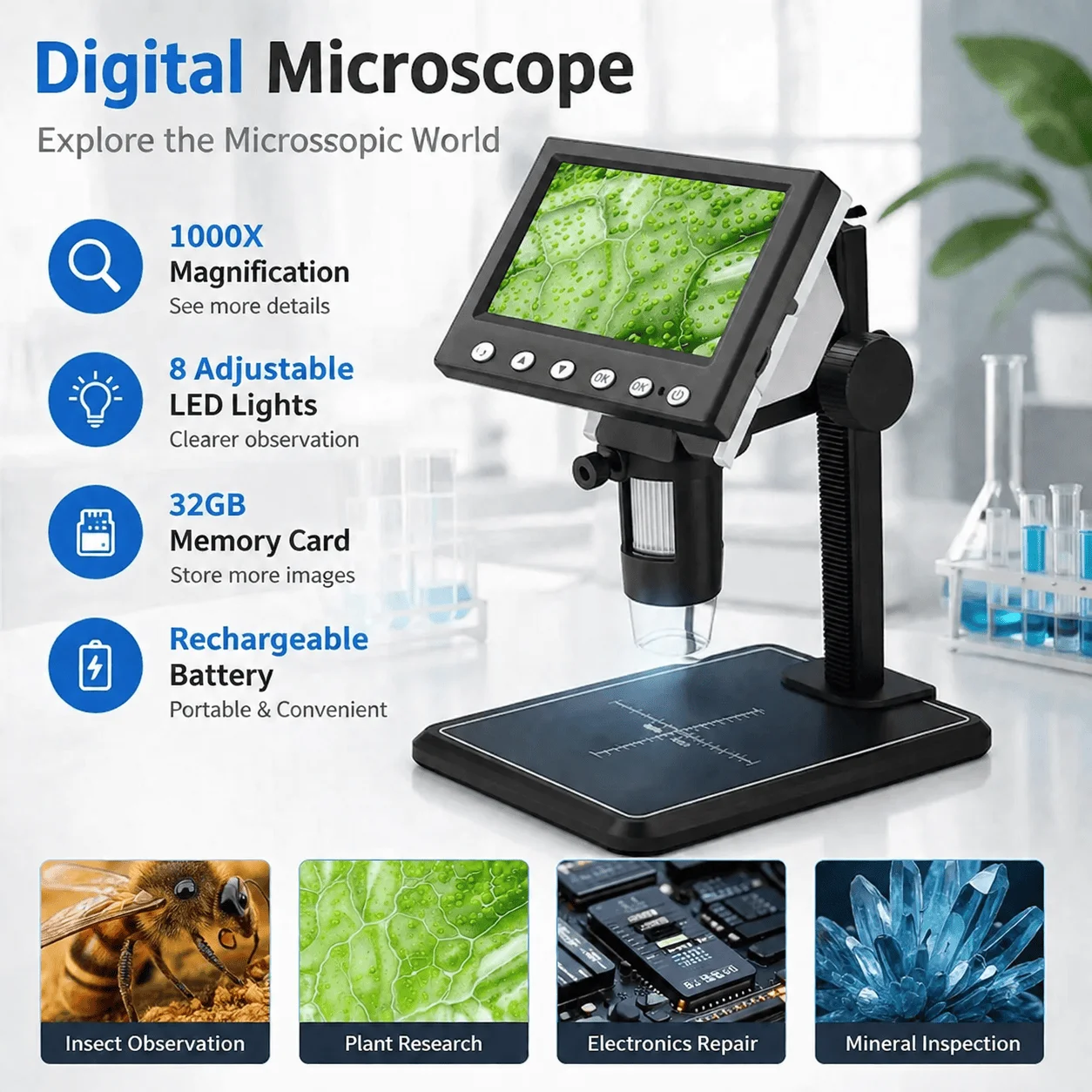
Listing #3 (offered by STONEGO003 Store at $30.09) advertises 4K resolution, 1000X magnification, and includes a 32GB memory card alongside an adjustable benchtop stand. While marketed under portable and field inspection queries, the included rack-and-pinion style stand provides mechanical stability that handheld wands lack. Note that on budget platforms, advertised "4K" labels frequently indicate interpolated firmware video files rather than a native 8MP optical sensor. Before purchasing, verify whether the native video stream outputs unscaled sensor data when connected via USB to Windows or Mac systems.
Side-by-Side Comparison of Handheld Options
The table below summarizes the key advertised features, form factors, and typical applications based on seller specifications:
| Model / Listing | Form Factor | Screen Claim | Sensor / Zoom Claims | Reference Price | Primary Use Case |
|---|---|---|---|---|---|
| Listing #1 (Stone's Store) | Vertical wand with 3-in-1 LEDs | 2.8" IPS | 2.0MP / 100X | $24.89 | Electronics check, UV coating analysis |
| Listing #2 (Shop1105185178) | Ultra-compact pocket gauge | 2.0" IPS | 1080P claimed | $17.89 | Tool pouch carry, quick spot checks |
| Listing #3 (STONEGO003 Store) | Hybrid scope with adjustable stand | Integrated console screen | 4K claim / 1000X / 32GB card | $30.09 | Static hobbyist viewing, coins, specimens |
| Listing #4 (Gevnnik Tool Store) | Horizontal paddle wand | 2.8" IPS | 2MP / 500X | $27.69 | PCB surface tracing, watch mechanism spot-check |
What to Verify Before You Order
When selecting a portable microscope from online marketplaces, consult the documentation or ask the seller these key verification questions:
- Native Sensor Resolution vs. Software Scaling: Does the microscope use a native 2MP (1080P) sensor, or is it a lower-resolution module (such as 0.3MP / VGA) upscaled via firmware? Native 2MP sensors produce legible markings on SMD IC packages; upscaled sensors display blurred artifacts.
- Illumination Control: Can the ring LEDs be dimmed? On shiny solder joints or metallic coin rims, full-blast lighting creates intense glare and specular reflections that wash out image contrast unless the light intensity can be dialed down.
- Image Capture and PC Streaming: Does the device save snapshots directly to an on-board microSD card (and is one included), or does it require a USB cable connection to a PC to record images?
- Working Clearance Requirements: If your task involves manipulating components while viewing them, a handheld wand will likely block your tools. Verify whether your task only requires looking at the subject or if you need the physical clearance of a dedicated stand.